Design of JSONB Storage Format
1. Design Goals
- To be compatible with the JSON format and capable of fully representing JSON.
- Compact, with no data gaps.
- Compact design for commonly used integers from -16 to 63.
- Compact design for null/true/false.
- Compact design for ARRAYs of length 0 to 15.
- Compact design for ASCII-encoded strings of length 0 to 47.
- Support for short encoding of OBJECT names (keys).
- Support for complete Java serialization and deserialization.
2. JSON Support Format Definition
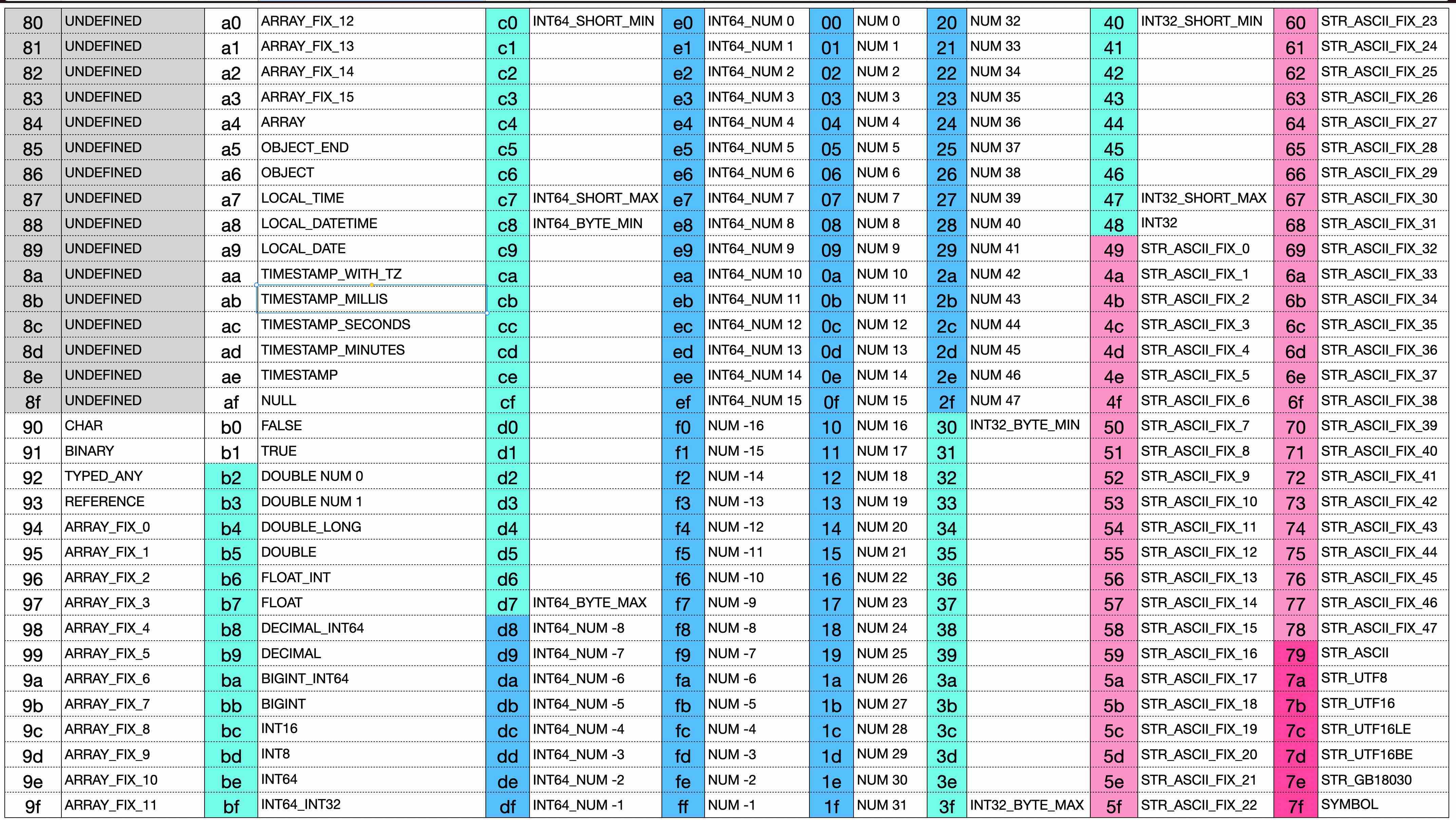
x90          # char
x91          # binary len_int32 bytes
x92          # type [str] symbol_int32 jsonb
x93          # reference

x94 - xa3    # array_0 - array_15
xa4          # array len_int32 item*

xa5          # object_end
xa6          # object_start

xa7          # local time b0 b1 b2
xa8          # local datetime b0 b1 b2 b3 b4 b5 b6
xa9          # local date b0 b1 b2 b3
xab          # timestamp millis b0 b1 b2 b3 b4 b5 b6 b7
xac          # timestamp seconds b0 b1 b2 b3
xad          # timestamp minutes b0 b1 b2 b3
xae          # timestamp b0 b1 b2 b3 b4 b5 b6 b7 nano_int32

xaf          # null
xb0          # boolean false
xb1          # boolean true
xb2          # double 0
xb3          # double 1
xb4          # double_long
xb5          # double
xb6          # float_int
xb7          # float
xb8          # decimal_long
xb9          # decimal
xba          # bigint_long
xbb          # bigint
xbc          # short
xbd          # byte
xbe          # long
xbf          # long encoded as 32-bit int ('Y')
xc0 - xc7    # three-octet compact long (-x40000 to x3ffff)
xc8 - xd7    # two-octet compact long (-x800 to x7ff, xd0 is 0)
xd8 - xef    # one-octet compact long (-x8 to xf, xe0 is 0)

xf0 - xff    # one-octet compact int
x00 - x2f    # one-octet compact int

x30 - x3f    # two-octet compact int (-x800 to x7ff)
x40 - x47    # three-octet compact int (-x40000 to x3ffff)
x48          # 32-bit signed integer ('I')

x49 - x78    # ascii string length 0-47
x79          # ascii-8 variable-length
x7a          # utf-8 variable-length
x7b          # utf-16 variable-length
x7c          # utf-16LE variable-length
x7d          # utf-16BE variable-length
x7e          # gb18030 variable-length
x7f          # symbol
3. Numeric Representation Design
JSONB supports the following numeric types:
- INT8
- INT16
- INT32
- INT64
- BIGINT
- DECIMAL
- FLOAT
- DOUBLE
The representation of numeric values is in a contiguous range from 0xb2 to 0x48.
3.1 INT32 Design
The number of bytes required to represent an INT32 varies depending on its value range.
| Value Range | Bytes Required | |—————————-|—————-| | -16 ~ 47 | 1 | | -2048 ~ 2047 | 2 | | -262144 ~ 262143 | 3 | | -2147483648 ~ 2147483647 | 5 |
* 0xf0 ~ 0x2f: Directly represents INT32 integers from -16 to 47, requiring only 1 byte without extra conversion.
* 0x30 ~ 0x3f: Represents INT32 integers from -2048 to 2047, requiring 2 bytes.
* 0x40 ~ 0x47: Represents INT32 integers from -262144 to 262143, requiring 3 bytes.
* 0x48 + <4_bytes>: The first byte is 0x48, followed by 4 bytes representing the value, requiring 5 bytes in total.
3.2 INT64 Design
| Value Range | Bytes Required | |——————————————-|—————-| | -8 ~ 15 | 1 | | -2048 ~ 2047 | 2 | | -262144 ~ 262143 | 3 | | -2147483648 ~ 2147483647 | 5 | | 0x8000000000000000L ~ 0x7fffffffffffffffL | 9 |
* 0xd8 ~ 0xef: Directly represents INT64 integers from -8 to 15, requiring only 1 byte.
* 0xc8 ~ 0xd7: Represents INT64 integers from -2048 to 2047, requiring 2 bytes.
* 0xc0 ~ 0xc7: Represents INT64 integers from -262144 to 262143, requiring 3 bytes.
* 0xbf + <4_bytes>: The first byte is 0xbf, followed by 4 bytes representing the value, requiring 5 bytes in total.
* 0xbe + <8_bytes>: The first byte is 0xbe, followed by 8 bytes representing the value, requiring 9 bytes in total.
3.3 INT8 & INT16
* 0xbd + <1_byte>: Represents INT8, requires 2 bytes.
* 0xbc + <2_bytes>: Represents INT16, requires 3 bytes.
3.4 BIGINT Representation Design
BIGINT has two representations:
* 0xba + <int64>: When the BIGINT's value is within the range 0x8000000000000000L ~ 0x7fffffffffffffffL, it is prefixed with a 0xba byte, requiring 2 to 10 bytes.
* 0xbb + <bytes_len> + <bytes>
3.5 DECIMAL Representation
DECIMAL has two representations:
* 0xb8 + <int64>: When there is no fractional part and the value is within the range 0x8000000000000000L ~ 0x7fffffffffffffffL, it is prefixed with a 0xb8 byte, requiring 2 to 10 bytes.
* 0xb9 + <scale_int32> + <int32|int64|bigint>
3.6 FLOAT Representation
FLOAT has two representations:
* 0xb6 + <int32>: Represents a FLOAT without a fractional part, requiring 2 to 6 bytes.
* 0xb7 + <4_bytes>: Requires 5 bytes.
3.7 DOUBLE Representation
DOUBLE has three representations:
* 0xb2 ~ 0xb3: Represents 0 and 1, occupying 1 byte.
* 0xb4 + <int64>: Represents a double without a fractional part, requiring 2 to 10 bytes.
* 0xb5 + <8_bytes>: Requires 9 bytes.
4. NULL/TRUE/FALSE
NULL/TRUE/FALSE are each represented by a single byte:
- 0xaf NULL
- 0xb0 FALSE
- 0xb1 TRUE
5. String Representation
There are several ways to represent strings:
* 0x49 ~ 0x78: Represents a LATIN1 string with a length of 0 to 47.
* 0x79 + <int32_bytes_len> + <bytes>: LATIN1 string.
* 0x7a + <int32_bytes_len> + <bytes>: UTF8 string.
* 0x7b + <int32_bytes_len> + <bytes>: UTF16 string.
* 0x7c + <int32_bytes_len> + <bytes>: UTF16LE string.
* 0x7d + <int32_bytes_len> + <bytes>: UTF16BE string.
* 0x7e + <int32_bytes_len> + <bytes>: GB18030 encoded string (this can reduce the length for Chinese characters).
* 0x7f + <int32_symbol>: If the symbol is negative, it is an index into the SymbolTable. If it is >= 0, it is a string symbol within the current data.
The string format is specifically designed to support LATIN1 encoded characters. This will be very helpful for improving string deserialization performance and will also benefit string serialization in Java 9+.
6. Date Representation
* 0xae + <int64_epoch_second> + <int32_nano>: TIMESTAMP, requires 3 to 15 bytes, corresponds to Java's Instant type.
* 0xad + <4_bytes_epoch_minutes>: TIMESTAMP_MINUTES, requires 5 bytes, corresponds to Java's Date type.
* 0xac + <4_bytes_epoch_seconds>: TIMESTAMP_SECONDS, requires 5 bytes, corresponds to Java's Date type.
* 0xab + <8_bytes_epoch_millis>: TIMESTAMP_MILLIS, requires 9 bytes, corresponds to Java's Date type.
* 0xaa + <2_bytes_year> + <1_byte_monthValue> + <1_byte_dayOfMonth> + <1_byte_hour> + <1_byte_minute> + <1_byte_second> + <int32_nano> + <str_zoneId>: Corresponds to Java's ZonedDateTime.
* 0xa9 + <2_bytes_year> + <1_byte_monthValue> + <1_byte_dayOfMonth>: Requires 5 bytes, corresponds to Java's LocalDate type.
* 0xa8 + <2_bytes_year> + <1_byte_monthValue> + <1_byte_dayOfMonth> + <1_byte_hour> + <1_byte_minute> + <1_byte_second> + <int32_nano>: Requires 8 to 12 bytes, corresponds to Java's LocalDateTime type.
* 0xa7 + <1_byte_hour> + <1_byte_minute> + <1_byte_second> + <int32_nano>: Requires 4 to 8 bytes, corresponds to Java's LocalTime type.
7. Object Type
An object type starts with 0xa6 and ends with 0xa5, containing any number of key-value pairs in between, as follows:
0xa6
    [<key_any> <value_any>]...
0xa5
8. Array Type
An array has two representations:
* 0x94 ~ 0xa3: Represents an array with 0 to 15 elements.
* 0xa4 + <int32_length> + <item...>
9. Reference
* 0x93 + <str_reference_path>
10. Typed_Any
This type enables complete serialization and deserialization.
* 0x92 + <str_typename> + <any>
11. Binary Type
0x91 + <int32_length> + <bytes>
12. char type
0x90 <byte1>