 qzBack to qz ↗
Credits
Website assets
These screenshots and the promotional film show actual qz browser sessions. The research table screenshots are captured from a new live task using official Playwright, Puppeteer, and Selenium documentation. The other feature screenshots are cropped from the original recordings to show the relevant panel. Product text and results are unchanged.
Feature screenshots show the Data table, image collection, Skill resource editor, custom result card, and parallel task tree. Frame and crop details.
Workspace screenshot credits
The workspace screenshots show qz collecting Hangzhou photographs in real Chrome sessions:
- English: extracted at 87.8 seconds from
v3/recordings/hangzhou.mov, the original recording used in the English promotional video. - Simplified Chinese: extracted at 104 seconds from
zh-v7/recordings/collect.mov, the original recording used in the Chinese promotional video.
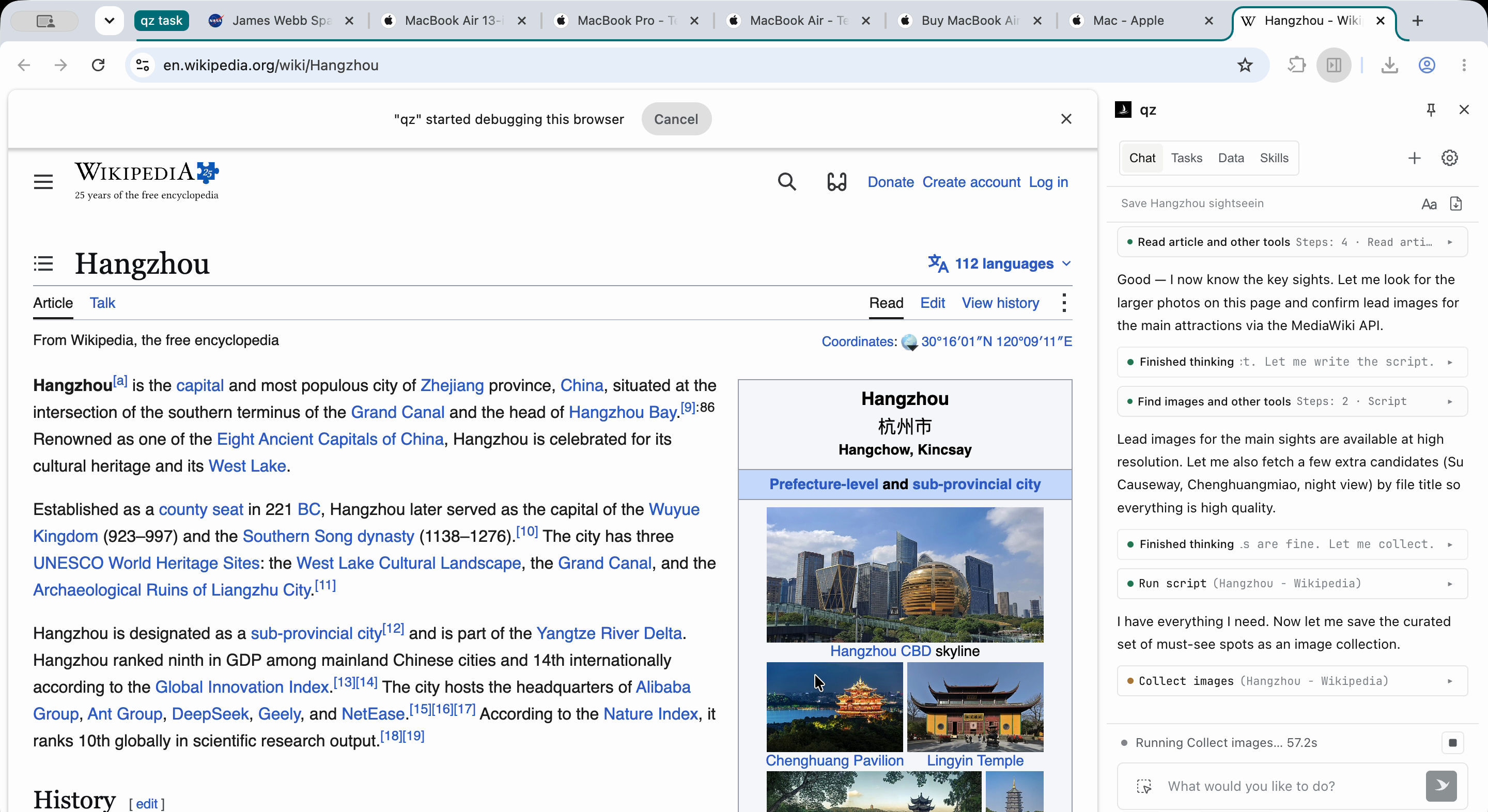
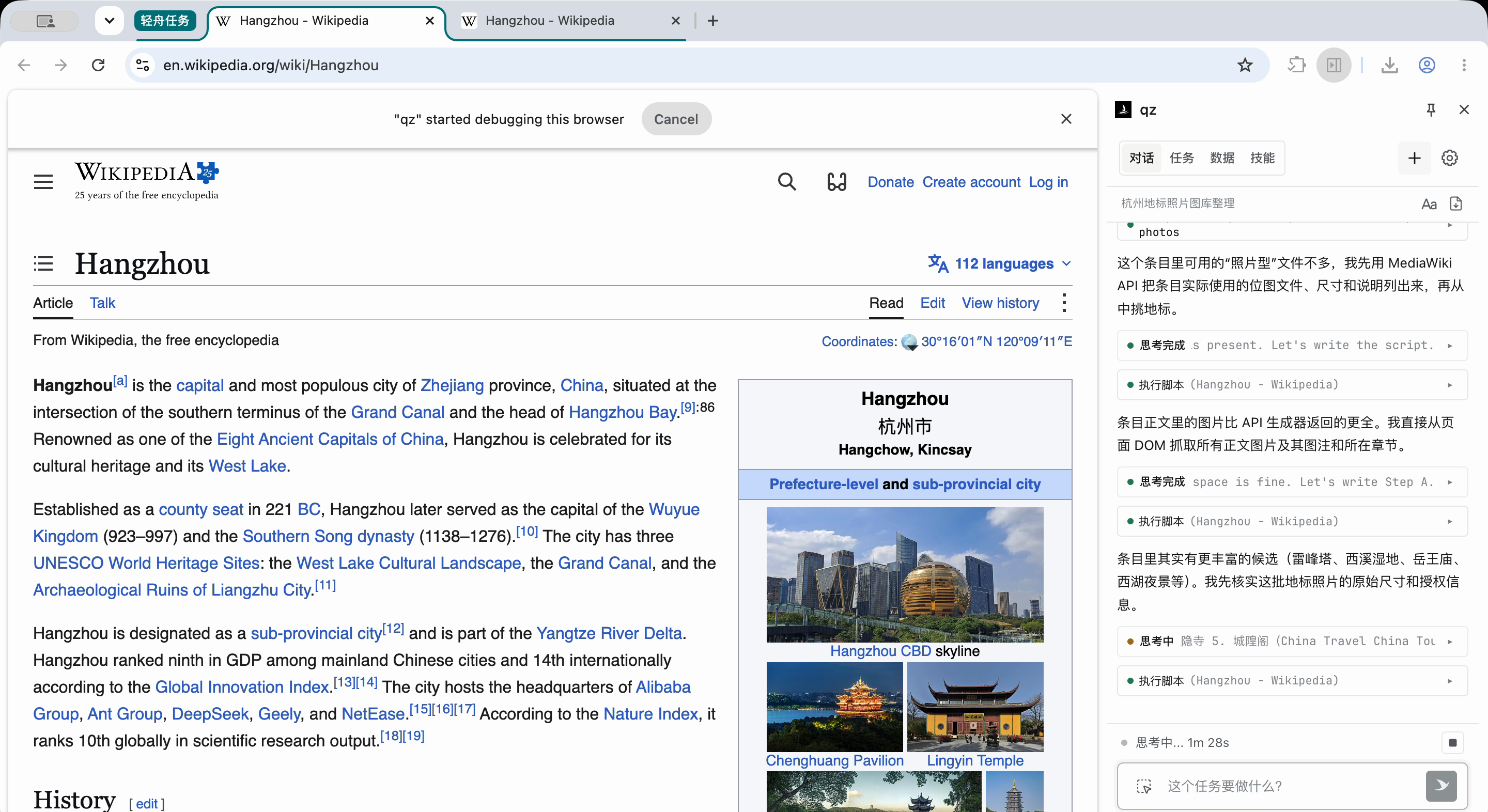
Both PNGs preserve the recordings' 2880-pixel width. The bottom model-selection footer is cropped, leaving 2880 × 1572 images. Browser and extension content retains its original appearance.
Wikipedia
Hangzhou article text is by Wikipedia contributors, under CC BY-SA 4.0.
Photographs
The source recordings use the Wikimedia photographs listed below. Article images and gallery thumbnails retain their respective licenses.
- File:201607 Z176 departs from Hangzhou.jpg — MNXANL; CC BY-SA 3.0.
- File:20240128 Liuhe Pagoda 01.jpg — Windmemories; CC BY-SA 4.0.
- File:62998-Hangzhou (49152700816).jpg — xiquinhosilva; CC BY 2.0.
- File:Aerial panorama of West Lake and its surrounding mountains. December 2023.jpg — Wanderingchina; CC BY 4.0.
- File:Aerial panorama of West Lake sunset and its lakeside district. December 2023.jpg — Wanderingchina; CC BY 4.0.
- File:Alibaba Center in Binjiang Hangzhou2021.jpg — Charlie fong; CC BY-SA 4.0.
- File:Chenghuangmiao (City God Pavilion), Hangzhou(2568).jpg — Mlq4296; CC BY-SA 3.0.
- File:Hupao.jpg — Sh1019; CC BY-SA 3.0.
- File:Leifeng Pagoda DJI 0593 (2).jpg — David290; CC BY-SA 4.0.
- File:Lingyin Temple, Hangzhou 20161003.jpg — Tyg728; CC BY-SA 4.0.
- File:Longjing tea.jpg — Difference engine; CC BY-SA 4.0.
- File:West Lake, Hangzhou 2025.jpg — Takashishin; CC BY 4.0.
- File:West Lake at night.jpg — Takashishin; CC BY-SA 4.0.
- File:Xixi Wetland Park, Hangzhou, China.jpg — Yoshi Canopus; CC BY-SA 3.0.
- File:Yue Fei temple 13.jpg — © Peter Potrowl; CC BY 3.0.
- File:拱宸橋·浙江杭州·(航拍自東南往西北).jpg — Legolas1024; CC BY-SA 4.0.


Credits — qz YouTube edition
This 45-second film uses actual qz extension interactions recorded in an isolated Chrome window. Live provider requests generated the reading summary, product comparison, saved table, image collection, and reusable site Skill. Recording excerpts play at their original speed; waiting time is removed with cuts. Browser tab selection and result browsing were operated during capture. Provider/model labels are masked in the final edit. No application screens or results are simulated.
Music and editing
Original 120 BPM instrumental synthesized for this film. No third-party music samples. Beat-aligned cuts, fixed framing, antialiased corners, side-panel compositing, and model-label masking were applied to recorded browser footage. Recording excerpts play at 1× speed. The four-panel sequence uses a shared five-second wall-clock interval from four concurrently recorded task windows. The multilingual ending retains its original timing and motion, redrawn in Alibaba PuHuiTi 2. Added video typography also uses Alibaba PuHuiTi 2. Native browser and extension typography is preserved.
Web pages
- NASA Webb mission: actual NASA Science page and telescope illustration, shown in a product-use demonstration. NASA and other credited owners retain their respective rights.
- Apple MacBook Air and MacBook Pro specifications: actual Apple product pages shown in a browser research demonstration. Product images, marks, and page design belong to Apple.
- Hangzhou — Wikipedia: page text under CC BY-SA 4.0; individual photographs carry their own licenses below.
Collected Wikimedia photographs
Photographs appear in the live browser and collection thumbnails; some are scaled or framed in the edit. The photographs retain their original licenses.
File:201607 Z176 departs from Hangzhou.jpg — MNXANL; CC BY-SA 3.0.
File:20240128 Liuhe Pagoda 01.jpg — Windmemories; CC BY-SA 4.0.
File:62998-Hangzhou (49152700816).jpg — xiquinhosilva; CC BY 2.0.
File:Aerial panorama of West Lake and its surrounding mountains. December 2023.jpg — Wanderingchina; CC BY 4.0.
File:Aerial panorama of West Lake sunset and its lakeside district. December 2023.jpg — Wanderingchina; CC BY 4.0.
File:Alibaba Center in Binjiang Hangzhou2021.jpg — Charlie fong; CC BY-SA 4.0.
File:Chenghuangmiao (City God Pavilion), Hangzhou(2568).jpg — Mlq4296; CC BY-SA 3.0.
File:Hupao.jpg — Sh1019; CC BY-SA 3.0.
File:Leifeng Pagoda DJI 0593 (2).jpg — David290; CC BY-SA 4.0.
File:Lingyin Temple, Hangzhou 20161003.jpg — Tyg728; CC BY-SA 4.0.
File:Longjing tea.jpg — Difference engine; CC BY-SA 4.0.
File:West Lake, Hangzhou 2025.jpg — Takashishin; CC BY 4.0.
File:West Lake at night.jpg — Takashishin; CC BY-SA 4.0.
File:Xixi Wetland Park, Hangzhou, China.jpg — Yoshi Canopus; CC BY-SA 3.0.
File:Yue Fei temple 13.jpg — © Peter Potrowl; CC BY 3.0.
File:拱宸橋·浙江杭州·(航拍自東南往西北).jpg — Legolas1024; CC BY-SA 4.0.
Custom Skill UI
The final product shot shows the actual saved wikipedia-city-photos tool result expanded in Chat, with its manifest-defined summary cards and image_grid renderer. The recorded UI displays data returned by the previously verified live Skill invocation.
Concurrent tasks and child research
The four-panel shot records four real qz tasks running simultaneously: NASA Webb reading, Apple laptop comparison, Hangzhou photo collection, and an HTML travel-guide build. The source seven-second recording interval is checked against each task's actual start and end times in qa/concurrency-check.json.
The child-agent sequence comes from a separate actual parent task. Two children researched West Lake walks and Longjing tea experiences concurrently, creating tables with 9 and 10 rows. The parent combined them into an 11-row itinerary. The footage shows the native task tree while both children run, followed by the actual combined artifacts. Browser inspection and result browsing during capture were operated locally. All seven new parent/child and independent tasks completed.
Additional source titles and links appear in the recorded research results, including NASA Science, TravelChinaGuide, China Discovery, Wikipedia, and Viator. The movie shows their incidental citations inside actual qz task output.
YouTube edit
This 45-second edition reuses the original source recordings. Browser pages and native sidebars are cropped and framed separately at selected points to improve readability. The original gallery showcase is replaced by Wikipedia reading and scripting; the Skill result card remains as a three-second custom-UI example. The parallel research task and its combined artifacts receive separate close-ups. Source clips retain 1× playback speed; pauses are removed through cuts. The original instrumental is rearranged for the new 120 BPM cut grid and normalized to approximately −16 LUFS. The seven-second multilingual ending includes the GitHub address. The thumbnail uses crops from the same Hangzhou recording.