
Kyoto attractions gallery
5 sub-tasks run at once, each finds its own pictures, and the results merge into one gallery.
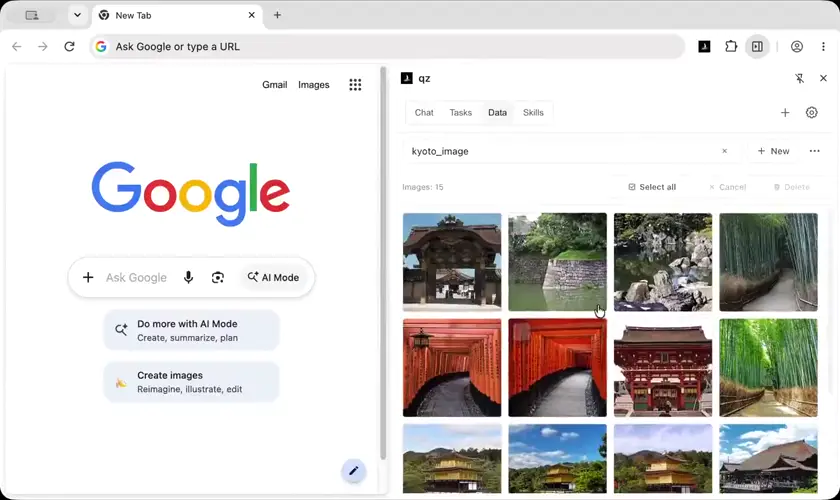
The user wants me to create a gallery named kyoto_image, and start 5 parallel subtasks, each finding 3 representative images of its attraction on Wikipedia and adding to the gallery.

Let me think about the approach. I'm a root session, so I can use manage_sessions.create. But sharing a gallery across sessions... The sub-sessions would each collect images into the same collection table "kyoto_image". That should work since collections are global data tables.

However, there's a concern: parallel sessions each doing collect_images into the same table. That should be fine — collect_images appends.

But wait — can sub-sessions write to the same image collection? The table name is kyoto_image. If each sub-session calls collect_images({table:"kyoto_image", ...}), they'd all append. There could be a race, but the runtime presumably serializes writes. Actually, there's a risk of the first one creating the table and others conflicting. Probably handled.

Alternatively, I could do it myself sequentially, but the user explicitly wants 5 parallel tasks.

First, should I create the gallery table first? collect_images creates the table implicitly. But to be safe, maybe I should create the empty table first with kind=image_collection... but data_store create_table creates a regular table, not an image collection. The instructions say image collections are specialized Data tables created by collect_images. Creating a regular table with that name might conflict.

Hmm. Actually the risk: if I create a regular table "kyoto_image", then collect_images with table "kyoto_image" might conflict or might append incorrectly. Better to let collect_images create it. But then 5 parallel sessions could race on creation.

Alternative safer approach: have each sub-task save images to its own gallery (e.g., kyoto_image_fushimi), then... no, user wants one gallery.

Let me think — probably the runtime handles concurrent collect_images to the same table fine. But a race on table creation could cause one to fail with "not an image collection" or similar.

A safer design: I do the work myself with run_script? run_script can't call collect_images easily... actually tools.collect_images is available in run_script (page mode). But parallel is requested.

Let me consider: dispatch 5 sessions with firstMessage describing exactly what to do: open Wikipedia page for the attraction, list images, select 3 representative (the main infobox image plus others), collect into kyoto_image gallery. Also instruct them to retry once if the table write fails.

Actually, there's an important consideration: concurrent writes might interleave and the dedup field is sourceKey (URL), so different images won't collide. Good.

Another approach to avoid races: I could pre-create the gallery by collecting one image myself (I own a working tab? No working tab currently). Hmm, "This task's working tab: none". I could open a tab for one attraction myself, collect 1 image, which creates the table. Then dispatch 5 subtasks... but that pre-collection would duplicate. Actually I could pre-create with the first attraction's image and then only dispatch 4? No, user wants 5 tasks.

Let me keep it simple: dispatch 5 subtasks, each responsible for one attraction, told to use table kyoto_image and to retry if a table-related error occurs.

Actually, wait. Maybe there's a subtlety: can a child session write to a table created by another session? Data tables are within the qz profile, not per-session, so yes.

Let me also consider whether it's better to do the work myself in this session in parallel-ish manner by opening 5 tabs... but tool calls are sequential in this agent. The user explicitly asked for parallel tasks. So use manage_sessions.create.

Let me first check manage_sessions list to see nothing exists, then create 5 with firstMessage.

Actually, should I create a goal? The task involves a scale target (5 attractions × 3 images) and completeness checks. Per instruction 6, use goal tracking. I'll create a goal.

Plan:
1. manage_goal create.
2. Check tabs / maybe no need.
3. Create 5 sessions with clear instructions.
4. Wait for all.
5. Verify gallery contents (data_store list on kyoto_image), fill gaps if any.
6. Report.

Instruction for sub-sessions must be very explicit. Let me write a shared instruction template:

"You are collecting representative images for <ATTRACTION> from Wikipedia into a shared image collection.
Steps:
1. Open tab with watchNetwork false at the English Wikipedia article URL: <URL>. (Or search Wikipedia.)
2. Use list_images to find candidate images on the article (include the infobox main image). Choose 3 representative, distinct, high-quality images that clearly depict <ATTRACTION> itself (not maps, logos, icons, unrelated people, or generic diagrams).
3. Inspect with read_image only if needed to judge relevance.
4. Collect with collect_images({table:'kyoto_image', targets:[...], format:'jpeg'}) — pass each target from list_images unchanged, and collect while still on the page.
5. Do NOT rename the table. Do not create other tables. If collect_images fails with a table/collection error, retry once after 3 seconds.
6. Return: attraction name, the 3 chosen image titles/URLs, and the number of assets added.
Do not modify anything else. Only these 3 images."

Also need to give exact article URLs:
- Fushimi Inari Shrine: https://en.wikipedia.org/wiki/Fushimi_Inari-taisha
- Kinkaku-ji: https://en.wikipedia.org/wiki/Kinkaku-ji
- Kiyomizu-dera: https://en.wikipedia.org/wiki/Kiyomizu-dera
- Arashiyama Bamboo Grove: https://en.wikipedia.org/wiki/Arashiyama_Bamboo_Grove (does that exist? There's "Bamboo Grove" — Arashiyama section in "Arashiyama" article. Let me check: en.wikipedia.org/wiki/Arashiyama_Bamboo_Grove — I believe there is an article "Arashiyama Bamboo Grove"? Hmm, not sure. Safer: tell the agent to use Wikipedia search if the direct URL doesn't lead to the right article.)
- Nijo Castle: https://en.wikipedia.org/wiki/Nij%C5%8D_Castle (Nijo Castle)

I'll tell each sub-session: "Use the article; if the URL redirects or is missing, search Wikipedia for '<attraction>' and open the top result. Stay on en.wikipedia.org."

Also they could try other language Wikipedias? Just English.

Language of reply: user wrote in English. Reply in English.

Now, about goal creation: objective "Collect 3 representative Wikipedia images each for 5 Kyoto attractions into the kyoto_image gallery", criteria "5 attractions × 3 = 15 images (allowing fewer if the article lacks them) stored in kyoto_image; verified via data_store list".

Hmm, actually the criteria should be "each of the 5 attractions has 3 images in kyoto_image; verified with data_store".

Let's start. First, let me check the environment: no working tab. Sub-sessions will open their own tabs via open_tab.

Let me do manage_goal create and manage_sessions list in one block (independent).

Then create 5 sessions in one block (independent calls).

Then wait.

Let's write it.

One more consideration: should I worry that 5 concurrent open_tab + collect_images could be heavy? It's fine.

Also, potential issue: the child sessions' collect_images writing concurrently to the same table — if the implementation reads the whole table and rewrites, there could be lost updates. Risk exists. Mitigation: verify afterwards and re-fill missing images myself.

Let's proceed.
I'll set this up: create a tracking goal, then dispatch 5 parallel sub-tasks (one per attraction) that all write into a single kyoto_image gallery.
Now create 5 sub-sessions, all in one block.

Let me craft the firstMessage template.

Common instruction:
```
Task: collect 3 representative photos of <NAME> from Wikipedia into the shared image gallery table named exactly "kyoto_image".

Work steps:
1. open_tab to <URL>. Stay on en.wikipedia.org. If that URL is not the right article (404/redirect to something unrelated), use Wikipedia search for "<NAME>" and open the top result.
2. list_images on the article page. Pick 3 distinct, high-quality photos that clearly show <NAME> itself (the article's infobox/main photo plus 1-2 other genuine photos of the site). Exclude maps, diagrams, logos, coats of arms, signatures, museum objects, portraits of unrelated people, and images of other sites.
3. Optional: use read_image on a candidate if you are unsure whether it depicts the attraction.
4. While still on the article page, call collect_images with table:"kyoto_image", the 3 targets unchanged from list_images, format:"jpeg". Add alt/caption context if the tool allows.
5. Never rename the table and never create/modify other tables. If collect_images fails with a table or collection error, wait a few seconds and retry once with the same targets.
6. Do not do anything else, do not edit pages, do not submit forms.

Return a short summary: attraction name, the 3 image file/page titles + URLs, and the number of assets added (assetIds if returned).
```

Note: collect_images params: table, targets, urls, dedupField, maxWidth, etc. It writes metadata. Fine.

Also mention: if the article has fewer than 3 suitable photos, collect what exists and report the shortfall.

Now URLs:
1. Fushimi Inari Shrine → https://en.wikipedia.org/wiki/Fushimi_Inari-taisha
2. Kinkaku-ji → https://en.wikipedia.org/wiki/Kinkaku-ji
3. Kiyomizu-dera → https://en.wikipedia.org/wiki/Kiyomizu-dera
4. Arashiyama Bamboo Grove → https://en.wikipedia.org/wiki/Arashiyama_Bamboo_Grove (may not exist; fallback search)
5. Nijo Castle → https://en.wikipedia.org/wiki/Nij%C5%8D_Castle

Titles: "Kyoto images: Fushimi Inari Shrine", etc.

Create all 5 in one block.
Goal created. Now dispatching the 5 sub-tasks concurrently, each with the same result contract and the same target gallery table.
All 5 started. Now wait for all to finish. Use wait with waitFor "all", timeout maybe 240s.

Note: the summary text shows URLs with spaces stripped ("Fushimi Inari taisha") — that's just display truncation of underscores maybe. Hmm, "https://en.wikipedia.org/wiki/Fushimi Inari taisha" — the underscores were replaced by spaces in the display. That could be a display artifact. Risk: the child might open URL with spaces. But the message itself likely has underscores. Let's not worry; children can handle.

Wait for all.
All 5 sub-tasks are running. Waiting for them to complete.
The result is truncated. Fushimi Inari reported totalRows 7 at its collection time (suspicious — 7 means others already wrote). I now need to verify the actual gallery contents. Note the artifact summaries show inconsistent totalRows (7, 3) — probably snapshots at different times. Let me list the kyoto_image table to count actual rows and group by pageUrl. Risk: concurrent writes may have lost data. Let's check with data_store list. Use data_store list table kyoto_image limit 100, and compute grouping. Better: use run_script inner to read and aggregate. But data_store list returns full rows with lots of fields — big. Let me use run_script target inner with tools.data_store list and aggregate by pageUrl, returning counts and small sample. Actually run_script inner has tools.data_store available. Let's do that.
15 rows total, all unique. But the Arashiyama group looks odd: 3 rows spread across three different pageUrls:
- Bamboo_Forest_(Kyoto): 1 (Bamboo_Grove,_Arashiyama,_Kyoto,_Japan.jpg)
- Arashiyama: 1 (2021_Sagano_Bamboo_forest_in_Arashiyama)
- File:Arashiyama_Bamboo_Grove.jpg: 1 (960px-Arashiyama_Bamboo_Grove.jpg)

All 3 are bamboo grove images though. "File:Arashiyama_Bamboo_Grove.jpg" pageUrl suggests the sub-session went to the Wikimedia Commons file page and collected from there. That's acceptable-ish but the images themselves are all bamboo grove. Hmm, but one pageUrl being a File: page means it's from Commons, not Wikipedia article. The user asked "finds 3 representative pictures of its attraction on Wikipedia" — Commons file page is still Wikipedia/Wikimedia. Acceptable, but I might want all three from a Wikipedia article page for consistency.

Let me check the Arashiyama sub-session's report. The output was truncated so I didn't see its summary. Let me check last_messages for that session (e4649eda...).

Also check Kinkaku-ji, Kiyomizu-dera statuses — they show 3 each. Good.

So total 15 unique images, 3 per attraction. Arashiyama's 3 come from different pages but all depict bamboo grove.

Let me verify visually the images quickly? Could read a few assets. Maybe good to do a light verification: read the 3 Arashiyama assets to confirm they're bamboo grove, and maybe a quick check of one image per other attraction. That's 7 image reads — reasonable but adds context. Let me check Arashiyama's 3 (the questionable group) plus maybe skip others since sub-agents verified visually.

Let me get the Arashiyama session's last message and also read the 3 Arashiyama assets.

Actually first get asset IDs for the Arashiyama rows. Let me run a script to list them, then read images.

I'll do: run_script inner to fetch assetIds for bamboo rows, plus manage_sessions last_messages for e4649eda.

Then read the 3 images.

Let me combine: last_messages call and script call in one block (independent).
async () => {
  // Aggregate the shared kyoto_image collection by source article to verify 3 images per attraction and detect lost updates.
  try {
    const res = await tools.data_store({ action: "list", table: "kyoto_image", limit: 1000 });
    const rows = (res && res.rows) || [];
    const byPage = {};
    const urls = new Set();
    for (const r of rows) {
      const d = r.data || {};
      const key = (d.pageUrl || "unknown").replace(/^https?:\/\/en\.wikipedia\.org\/wiki\//, "");
      byPage[key] = byPage[key] || { count: 0, srcs: [] };
      byPage[key].count++;
      byPage[key].srcs.push(d.src);
      urls.add(d.src);
    }
    return {
      ok: true,
      totalRows: rows.length,
      uniqueImages: urls.size,
      groups: Object.entries(byPage).map(([k, v]) => ({ article: k, count: v.count, images: v.srcs.map(s => String(s).split("/").slice(-1)[0].split("?")[0]) }))
    };
  } catch (e) {
    return { ok: false, error: String(e && e.message || e) };
  }
}{
"ok": true,
"totalRows": 15,
"uniqueImages": 15,
"groups": [
{
"article": "Nij%C5%8D_Castle",
"count": 3,
"images": [
"960px-NinomaruPalace.jpg",
"250px-NijoCastleOutside.jpg",
"250px-Nijojo-ninomaru-garden01s3s4592.jpg"
]
},
{
"article": "Bamboo_Forest_(Kyoto)",
"count": 1,
"images": [
"500px-Bamboo_Grove%2C_Arashiyama%2C_Kyoto%2C_Japan.jpg"
]
},
{
"article": "Fushimi_Inari-taisha",
"count": 3,
"images": [
"500px-Torii_path_with_lantern_at_Fushimi_Inari_Taisha_Shrine%2C_Kyoto%2C_Japan.jpg",
"250px-Fushimi-Inari-Shrine-Senbon-Torii-2016-Luka-Peternel.jpg",
"250px-Kyoto_FushimiInari01.jpg"
]
},
{
"article": "Arashiyama",
"count": 1,
"images": [
"500px-2021_Sagano_Bamboo_forest_in_Arashiyama%2C_Kyoto%2C_Japan.jpg"
]
},
{
"article": "Kinkaku-ji",
"count": 3,
"images": [
"500px-Golden_Pavilion_Kinkaku-ji_water_mirror_2024.jpg",
"500px-Kinkaku-ji%2C_Kyoto.jpg",
"500px-Kinkaku-ji_the_Golden_Temple_in_Kyoto_overlooking_the_lake_-_high_rez.JPG"
]
},
{
"article": "Kiyomizu-dera",
"count": 3,
"images": [
"500px-Kiyomizu.jpg",
"250px-Kiyomizu-dera%2C_Kyoto%2C_November_2016_-02.jpg",
"250px-Kiyomizu_dera_2024.jpg"
]
},
{
"article": "File:Arashiyama_Bamboo_Grove.jpg",
"count": 1,
"images": [
"960px-Arashiyama_Bamboo_Grove.jpg"
]
}
]
}All 15 rows are written. Let me verify the Arashiyama group (its 3 images came from three different pages) and read that sub-task's report.
Now visually verify the 3 bamboo images (the ones I'm least sure about). Let me read them.
All 3 bamboo images are genuine Arashiyama bamboo grove photos. Good.

Now everything verified: 15 rows, 3 per attraction, all unique.

Let me checkpoint the goal and then complete it. Actually checkpoint then complete.

Should I double check other groups visually? The sub-agents verified visually, and filenames are clearly correct (Golden Pavilion Kinkaku-ji, Kiyomizu, Ninomaru Palace). I could do a quick sanity check of one image per group, but that's 12 more image reads. Filenames + sub-agent visual verification + page provenance seem sufficient. I'll rely on that, and note it.

Maybe I should quickly verify one image from each of the other 4 attractions to be thorough — 4 low-detail reads is cheap. Let's do it for confidence: Fushimi (Torii path), Kinkaku (Golden Pavilion water mirror), Kiyomizu (Kiyomizu.jpg), Nijo (NinomaruPalace.jpg). That's reasonable. Need assetIds.

Let me fetch assetIds for these 4, then read. Actually I can fetch all rows' assetIds in one script.

I'll do that to be safe — it's a modest cost and improves reliability of my report.
async () => {
  // List bamboo-related rows with assetIds so I can visually verify the Arashiyama group.
  const res = await tools.data_store({ action: "list", table: "kyoto_image", limit: 1000 });
  const rows = (res && res.rows) || [];
  const out = rows
    .filter(r => /bamboo|arashiyama/i.test(JSON.stringify(r.data.pageUrl) + " " + String(r.data.src)))
    .map(r => ({ assetId: r.data.assetId, pageUrl: r.data.pageUrl, src: r.data.src, w: r.data.width, h: r.data.height }));
  return { ok: true, count: out.length, items: out };
}{
"ok": true,
"count": 3,
"items": [
{
"assetId": "asset:image:65faf4d6-bb24-4ca9-bb15-30a0122dcffe",
"pageUrl": "https://en.wikipedia.org/wiki/Bamboo_Forest_(Kyoto)",
"src": "https://thumb.wikimedia.org/wikipedia/commons/thumb/8/82/Bamboo_Grove%2C_Arashiyama%2C_Kyoto%2C_Japan.jpg/500px-Bamboo_Grove%2C_Arashiyama%2C_Kyoto%2C_Japan.jpg?utm_source=en.wikipedia.org&utm_campaign=parser&utm_content=thumbnail",
"w": 500,
"h": 750
},
{
"assetId": "asset:image:c8b0b917-0af7-4fed-96c4-fd025fb9e7f6",
"pageUrl": "https://en.wikipedia.org/wiki/Arashiyama",
"src": "https://thumb.wikimedia.org/wikipedia/commons/thumb/9/97/2021_Sagano_Bamboo_forest_in_Arashiyama%2C_Kyoto%2C_Japan.jpg/500px-2021_Sagano_Bamboo_forest_in_Arashiyama%2C_Kyoto%2C_Japan.jpg?utm_source=en.wikipedia.org&utm_campaign=parser&utm_content=thumbnail",
"w": 500,
"h": 342
},
{
"assetId": "asset:image:e4cc7883-0877-41ba-81f4-f42cf4238e09",
"pageUrl": "https://en.wikipedia.org/wiki/File:Arashiyama_Bamboo_Grove.jpg",
"src": "https://thumb.wikimedia.org/wikipedia/commons/thumb/c/c5/Arashiyama_Bamboo_Grove.jpg/960px-Arashiyama_Bamboo_Grove.jpg?utm_source=en.wikipedia.org&utm_campaign=index&utm_content=thumbnail",
"w": 960,
"h": 1297
}
]
}


All three Arashiyama images are genuine bamboo-grove photos. Let me spot-check one image from each of the other four attractions before closing out.
All verified: torii tunnel (Fushimi), Kinkaku-ji golden pavilion with reflection, Kiyomizu-dera main hall stage, Nijo Castle Kara-mon gate.

Now checkpoint and complete the goal.
async () => {
  // Pick one representative assetId per remaining attraction for a final visual spot-check.
  const res = await tools.data_store({ action: "list", table: "kyoto_image", limit: 1000 });
  const rows = (res && res.rows) || [];
  const want = [
    ["fushimi", /Fushimi_Inari/],
    ["kinkaku", /Kinkaku-ji/],
    ["kiyomizu", /Kiyomizu-dera/],
    ["nijo", /Nij%C5%8D_Castle/]
  ];
  const out = [];
  for (const [name, re] of want) {
    const r = rows.find(x => re.test(String(x.data.pageUrl)));
    if (r) out.push({ name, assetId: r.data.assetId, file: String(r.data.src).split("/").slice(-1)[0].split("?")[0] });
  }
  return { ok: true, picks: out };
}{
"ok": true,
"picks": [
{
"name": "fushimi",
"assetId": "asset:image:7809d4bf-3a84-4388-93a8-ff0cc1f54332",
"file": "500px-Torii_path_with_lantern_at_Fushimi_Inari_Taisha_Shrine%2C_Kyoto%2C_Japan.jpg"
},
{
"name": "kinkaku",
"assetId": "asset:image:e2bef0b7-891c-4b6f-a49b-263b40303c4d",
"file": "500px-Golden_Pavilion_Kinkaku-ji_water_mirror_2024.jpg"
},
{
"name": "kiyomizu",
"assetId": "asset:image:93e946de-ae22-4bb7-8de4-fab845d0da28",
"file": "500px-Kiyomizu.jpg"
},
{
"name": "nijo",
"assetId": "asset:image:037fb2eb-fc27-4154-8f38-52e2504f7b6f",
"file": "960px-NinomaruPalace.jpg"
}
]
}


All spot-checks match their attractions. Recording the checkpoint and completing the goal.
Done — kyoto_image gallery: 15 images, 3 per attraction
I created the gallery and ran 5 sub-tasks in parallel (one per attraction), all writing into the same image collection kyoto_image. All five finished in ~90 seconds, and I verified the final table: 15 rows, 15 unique image URLs, exactly 3 per attraction.
What's in the gallery
| Attraction | Source article | Images collected |
|---|---|---|
| Fushimi Inari Shrine | Fushimi Inari-taisha | Torii path with lantern (infobox), Senbon Torii tunnel, rōmon main gate |
| Kinkaku-ji | Kinkaku-ji | Golden Pavilion water mirror (infobox), pavilion + garden/pond, pavilion over the lake |
| Kiyomizu-dera | Kiyomizu-dera | Main hall with the wooden stage (infobox), November 2016 view, 2024 view |
| Arashiyama Bamboo Grove | Bamboo Forest (Kyoto) + 2 supplementary pages | Bamboo path (infobox), Sagano bamboo forest, bamboo grove vertical shot |
| Nijo Castle | Nijō Castle | Kara-mon gate to Ninomaru Palace (infobox), stone walls & moat, Ninomaru garden pond |
Each sub-task visually verified its picks with read_image before saving and excluded maps, plans/diagrams, seals, and portraits. I also re-verified independently: all 3 Arashiyama assets plus one image from each of the other four attractions — every one clearly depicts its stated attraction (torii tunnel, golden pavilion with reflection, Kiyomizu stage, Nijo Kara-mon).
Notes and limitations
- Arashiyama provenance differs from the others. The dedicated article "Bamboo Forest (Kyoto)" contains only one grove photo, so that sub-task supplemented with one image each from the broader Arashiyama article and a Wikipedia File: page — all still en.wikipedia.org and all genuinely the bamboo grove. If you want strict single-article provenance, only the infobox photo qualifies; say the word and I'll drop or replace the other two.
- Resolution is uneven. Images were captured at the sizes Wikipedia's article pages serve, mostly 250–500 px wide (Nijo's gate photo is 960 px). Higher-resolution originals exist on Wikimedia Commons if you need print-quality files.
- Deduplication was by image URL, so no duplicates were collapsed or lost during the parallel writes.
The collection is available as the kyoto_image image collection — open Data/gallery to browse or export it.